Showing posts with label Resource. Show all posts

Thursday, 11 August 2016

Ultrasound App: Pocket Emergency Ultrasound

Pocket Emergency Ultrasound is a free app that can be found at the App store.

This app provides information on interpretation of ultrasound images in 6 systems: 
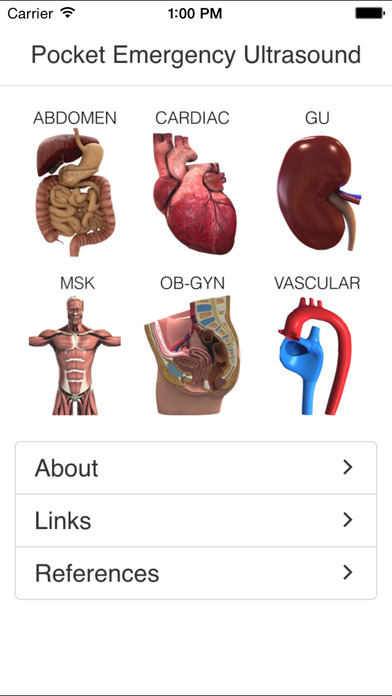

In each system, a labelled image with normal values for ultrasonography interpretation is presented. See the aortic root example below:


This App provides a quick reference to look up the relative position of structures in various ultrasound views as well as the normal reference ranges for these structures. However, this App does not provide information on probe positioning or on capturing these images. This App serves as a good resource for quick identification and interpretation of various structures in the systems listed above.

Another good feature of this App is the "Links" Section on the home page, which provides links to Emergency and Intensive Care Ultrasound resources, online lectures, image archives and core articles. Some of the links don't work, but most of them do work and provide great background information on point of care ultrasound. 

Overall, this App serves both as a quick reference guide for point-of-care ultrasound interpretation as well as a source of information for those with background knowledge in point-of-care ultrasound.


Tuesday, 2 August 2016

Lung Ultrasound Online Module

The Toronto General Hospital Department of Anesthesia has a point of care lung ultrasound module on their website. Unfortunately, their is no App version of this module.


This module allows you to view lung ultrasound images from 6 different views with the linear, convex and cardiac probes. Much like their cardiac ultrasound module, the lung reconstruction in the top left corner helps you to relate the images obtained with the probe positioning and anatomy. There is also information on the different structures visualized, commonly seen artifacts, and the assessment possibilities of the different views. 

This module provides a general overview on lung ultrasound including how to obtain various lung ultrasound images and how to identify certain structures. This module, however, does not contain any ultrasound images related to pathological findings. 

Overall, this is a great module for anyone new to lung ultrasound or for those who wish to review the normal structures as well as the common ultrasound views. 


Tuesday, 26 July 2016

FOCUS App

The Toronto General Hospital Department of Anesthesia has an app for Cardiac Ultrasound. Their FOCUS (FOcused Cardiac UltraSound) app is also available to download in the App Store.


This app has several different features. Firstly, it gives a great overview on the different ultrasound views of the heart, including how to obtain these views, how to optimize these views and which structures are assessable with each view. Another great feature of this app is that is provides a great overview of the anatomy with the use of educational diagrams with key anatomical structures labelled. The images and diagrams are clear and easy to read.


The FOCUS app also provides an overview and examples of normal and abnormal pericardium, left ventricular funciton, right ventricular function, and volume status. 


This is a great user-friendly and interactive app for anyone who is just starting to learn how to perform bedside cardiac ultrasound, as well as anyone who needs a quick reminder on the essential points. 


Monday, 18 July 2016

Critical Care Guidelines - Part 2

The second part of the Society of Critical Care Medicine's guidelines regarding bedside ultrasonography have recently been posted on their website. This part of the guidelines, by Levitov et al., focuses on cardiac bedside ultrasonography in the critical care setting.

The link can be found here: SCCM: Cardiac Ultrasonography

This guideline lists several class 1 recommendations for the use of bedside cardiac ultrasonography based on the GRADE system, which demonstrates that there is evidence to support the use of beside cardiac ultrasonography in the evaluation of the critically ill patient.

Sunday, 5 June 2016

Lung Ultrasound Resource

This resource at Handsonecho by Prof Dr. Daniel Lichtenstein is a great educational resource for lung ultrasound. Included in these short educational videos is the BLUE protocol for acute respiratory failure.

I've also included link to an open access article on lung ultrasound by Prof Dr. Daniel Lichtenstein titled Lung ultrasound in the critically ill.


Thursday, 26 May 2016

Podcast Resource


Ultrasound Podcast is a great resource with podcasts that discuss the applications of bedside ultrasound. Their podcasts include recent trials as well as plenty of cases and ultrasound images. 


Sunday, 22 May 2016

Two great resources


Here are two websites with guidelines, resources and modules for ultrasound training.


The first is The American Institute of Ultrasound in Medicine's website, which includes physician training guidelines, official statements, ultrasound parameters as well as an ultrasound curriculum.


The second is the Society of Ultrasound in Medical Education's website. It includes a curriculum database of curricula from several different universities as well as learning modules that range from ultrasound theory to its application.

Both of these websites contain great resources for medical professionals at any level of ultrasound training looking to refine their skills, attend an upcoming ultrasound worksop/conference, teach ultrasound skills to learners, or develop an ultrasound curriculum for their institution.

Friday, 20 May 2016

Critical Care Guidelines - Part 1

Part 1 of the Society of Critical Care Medicine Guidelines for Bedside Ultrasonography were published by Frankel et al. in November of 2015. These guidelines include recommendations on several non-cardiac applications of bedside ultrasonography in critically ill patients. In particular, there were strong recommendations for the use of ultrasound in procedures such as thoracentesis, paracentesis and central line insertion.

The written guidelines can be found here. There is also an iCritical Care Podcast by Dr. Ludwig Lin and Dr. Michael Blavais that comments on these guidelines, discusses the integration of technology into ultrasound application and practice, and provides suggestions for ultrasound training of learners and practicing physicians.

Part 2 of these guidelines, which includes the cardiac applications of bedside ultrasonography, have recently been published, and I will post the link once they are up on the Society of Critical Care Medicine's website.